
Lake Bunyonyi
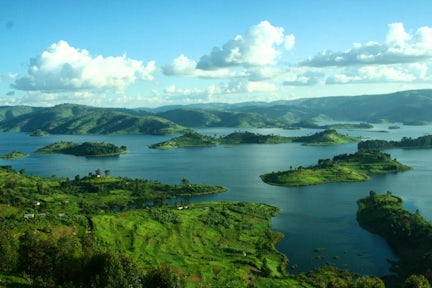
Lake Bunyonyi is found in the south-western part of Uganda near the border with Rwanda in Kabale District. Lake Bunyonyi is one of the most naturally beautiful lakes in Africa and is one of the leading tourist destinations in Uganda. The lake attracts tourists, honeymooners and Ugandans who wish to get away from the busy town life and enjoy the cool weather and beautiful islands. The lake offers great panoramic views from all sides and is a great place to go for meditation and relaxation.
The name Bunyonyi means “a place with little bird” in reference to the fact that the lake and its islands are home to an amazing collection of bird species. It is one of the deepest lakes in Africa. Lake Bunyonyi area has a generally cool climate throughout the year with enough rain that support the lush green hills surrounding the lake. It is the perfect place for relaxation after visiting Uganda’s great national parks like Bwindi and Queen Elizabeth National Park.
Introduction to lake Bunyonyi
Though the depth of the water is debated, it’s considered to be a maximum of 40 metres (roughly 130 feet).
It enjoys a warm, tropical climate all year round, with the luxury of a cool breeze in both morning and evening.
The views make it the perfect place for a little R&R after gorilla trekking in nearby Bwindi Impenetrable National Park.
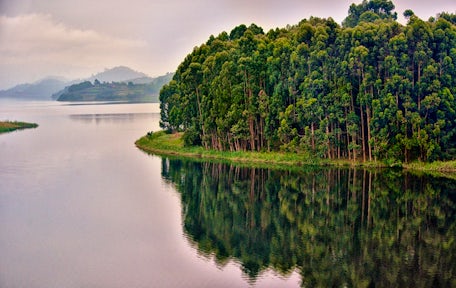
Where is Lake Bunyonyi?
The lake is based in south-western Uganda, sandwiched between Kabale (53 km away) and Kisoro (48 km away).
To reach the lake, you can catch a matatu (minibus) from Kampala, taking you to Kabale within 6.5 hours. From Kabale, you can hire a taxi, or rent a car, to complete the journey within 1.5 hours.
Alternatively, you can catch a 1.5 hour flight from Entebbe to Kihihi. Once arriving in Kihihi, you can either hire a taxi, or rent a car, and drive to Lake Bunyonyi in roughly 3 hours.
This can seem overwhelming, but don’t let it put you off from visiting the lake, as we can take care of all of this for you.

Ecology
Lake Bunyonyi Uganda has been named one of the safest lakes in Africa. There are no crocs, hippos, or risk of bilharzia.
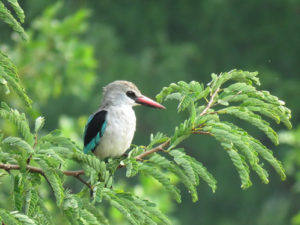
Instead, the island is home to over 200 species of birds. Grab a notepad and binoculars and spend hours discovering everything from weaver birds to grey-crowned cranes. It’s the perfect place for bird enthusiasts.
If you’re wanting to spend an afternoon on the water spotting marine life, you’ll be pleased to hear that African clawless otters and spotted-necked otters reside at the lake. There are also various frogs, fish, and shrimp.
In the surrounding islands, you can find monkeys and zebras.
On top of wild and marine life, vegetation is plentiful and the lake bursts with papyrus, swamp sawgrass, and blue lotus.

Discover the islands on Lake Bunyonyi Uganda
The lake encircles 29 islands, each overflowing with stories. However, 3 are spoken about most frequently: Akampene, Bwama, and Njuyeera.
Akampene (Punishment Island)
The account of this small island is sinister.
Up until the early 20th century, it was considered shameful to be unmarried and pregnant in Uganda. Therefore, the head of the family, usually the father, would take an unmarried, pregnant woman to Akampene in a canoe.
They would be left there to die, from either hunger or drowning in their attempt to swim home.
In other areas, women would be punished by being abandoned in forests, tied to trees, or left to wild animals. All the while, the men who got unmarried women pregnant would be left unpunished.
However, some were saved by their partners, who would row out, and they’d travel away from Lake Bunyonyi to start a life together. The farmers and poor men, who didn’t have the cows to pay for a bride, would also save them.
This practice was abandoned in the first half of the 20th century, as missionaries moved to the surrounding islands.

Bwama
In 1921 an English missionary, Dr Leonard Sharp, moved to Uganda. In 1931, he established a treatment centre for leprosy on Bwama. As well as that, he built a medical facility, patient quarters, and a church.
Local people suffering from leprosy were encouraged to voluntarily segregate themselves from their communities at Bwama to prevent infecting others.
The treatment available was a course of painful injections, administered over months. The centre was shut down in the 1980s, however, the hospital buildings are now used by two boarding schools.

Njuyeera (Sharp’s Island)
In 1931 Dr Leonard Sharp moved his family to Njuyeera. The island, fondly named ‘White Cottage’ (after the family home), became famous for its beauty after Mrs Sharp spent many years planting and nourishing trees, shrubs, fruits, and vegetables. She was known for her gardening talents and cheerful attitude, despite being a very busy woman.
Visitors were welcome at the island, and Mrs Sharp kept a note of all arrivals in a book. School groups would regularly come on outings to see the gardens, as well as the tennis court, boathouse, and guest cottage.
People were entertained with food and games. Occasionally, evening parties for people from Kabale would be hosted, whereby guests would stay overnight in tents.
Sadly, a lot of the history has now been stripped from Njuyeera as it’s been converted into a large hotel.
What can I do at Lake Bunyonyi?
While the lake is the perfect place to read a book and relax, there are plenty of fun activities to get stuck into on your visit.
Swimming is a great way to explore and connect to the surrounding nature, and you may even spot some marine life.
If swimming isn’t your thing, but you can’t resist the clear water, tour the surrounding islands by dugout canoe (a common mode of transportation), or going on a boat cruise.
After your time on the water, a long nature walk will show you another facet of this beautiful destination. You don’t need to be an experienced hiker, there are plenty of easy trails for you to follow.
If you’re after a bigger challenge and cultural experience, try a community walk through the surrounding villages. This is a great way to get a sense of traditional culture.
You’ll be introduced to the local way of life, by meeting families, farmers, and visiting community projects.
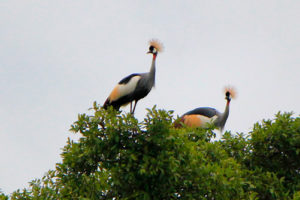 The species include both resident and those that migrate from Europe during the harsh winters. One of the best birding spots is the swamp of Nyombi. The best way to see the birds is by acquiring a boat, a binoculars and moving to the water with a birding guide. Some of the species include egrets, slender-billed baglafetch, weaverbirds, herons, grey crowned cranes and the levillant cuckoo among many others.
How to get to Lake Bunyonyi
Lone travelers to Lake Bunyonyi need to first get to Kabale town. It takes 8 hours of driving by car to reach Kabale town from Kampala. It takes between 20 to 30 minutes at most to reach the lake from Kabale town. To reach the Lake from Kabale town, one needs to hire a bodaboda (motorcycle) or taxi. Those coming from a safari in either Queen Elizabeth or Kibale National Park will need to travel for about 5 hours on road before reaching the lake. Lake Bunyonyi is closer to Kigali in Rwanda than Kampala (Uganda’s capital). It takes 3 hours of driving by car to reach the lake.